Friday, 23 September 2016

Short Film Analysis 3 - THE BLACK HOLE - Jacob Knowles

THE BLACK HOLE Analysis

THE BLACK HOLE, Philip Sansom, 2013

The short film the black hole explores the concept of what somebody may do if they had the ability to reach through solid surfaces. An office worker is given this power when he prints a large black spot onto a piece of paper, realising the ability of the black spot when he accidentally puts his drink down on it and it falls through into nothingness. The man realises he can reach into a vending machine, taking food from the machine. The man quickly realises the potential of his ability and becomes greedy, using the black hole to break into an office and to take money from the safe there. However the man's greed does not pay off as he falls into the black hole while reaching into the safe, getting trapped in there himself. 
Media Language in THE BLACK HOLE:

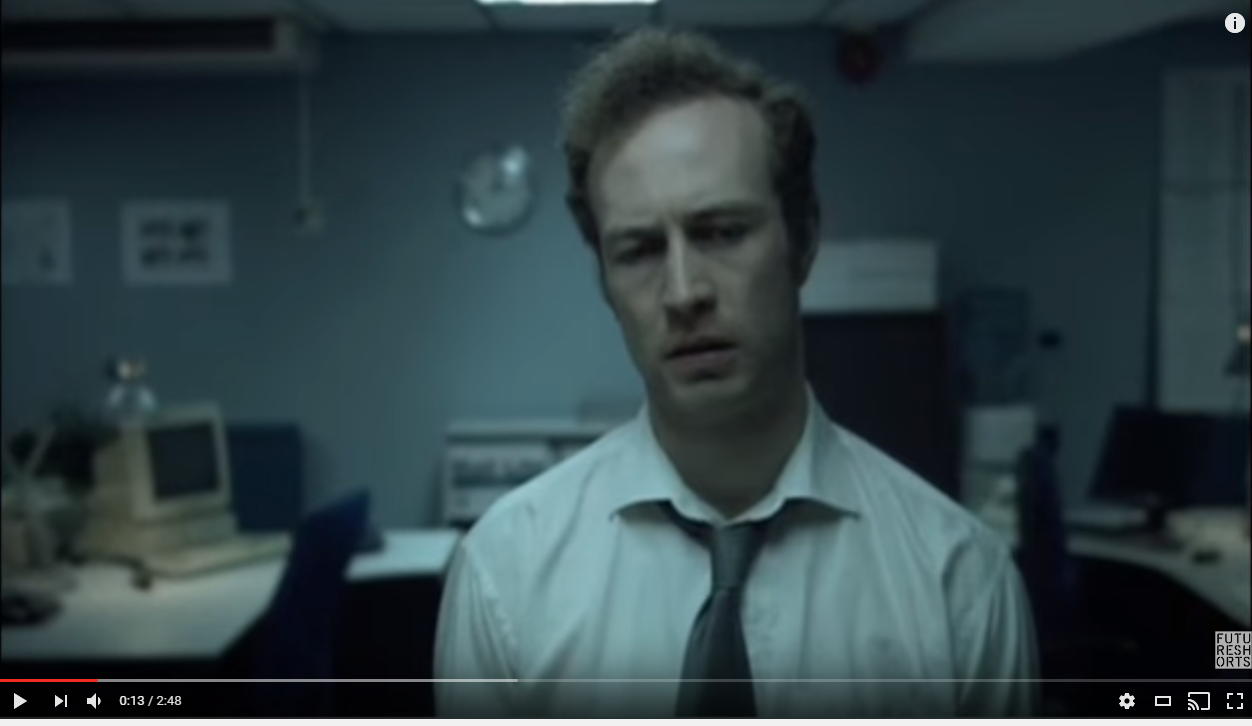
In the beginning of THE BLACK HOLE, we can see a very brief title sequence, lasting no more than 5 seconds. The title sequence has a black screen with the text 'The Black Hole' over it, the black on the screen wipes in a circular shape growing from the center of the screen leaving the title in the center to dissolve out of the frame. The next shot we see is fairly complex, it pans and zooms towards the main character at the same time while pulling the focus onto him at the same time. As this happens the man looks very bored and despondent, the costume that he's wearing is a white shirt and messy tie which makes him look like he doesn't really care about his job or what he's currently doing and that he'd rather not be there. The lighting in the whole sequence is fairly drab and dark, emphasising the man's facial expressions. We can see that we are in an office setting through the mise en scene of just this shot, there is a clock on the wall, a printer, computers on desks, and grey walls. The man's costume as mentioned earlier also shows this to be an office setting. Next, we see an OTS shot of him pressing a button on the printer in front of him, the sequence then cuts to a medium profile shot of  him as he has a confused expression on his face. We then quickly cut back to a shot of him repeatedly pressing the button, and then to a close-up of him kicking the printer in an attempt to get it to work. This brief increase in pace in the sequence shows the character's frustration as he attempts to get the printer to work. We then cut to a bird's eye view shot of the black spot coming out of the printer, the pace of the sequence still remaining high. Next, we see a close up shot of the main character looking at the black spot in confusion, not knowing what it is or what it could be used for.
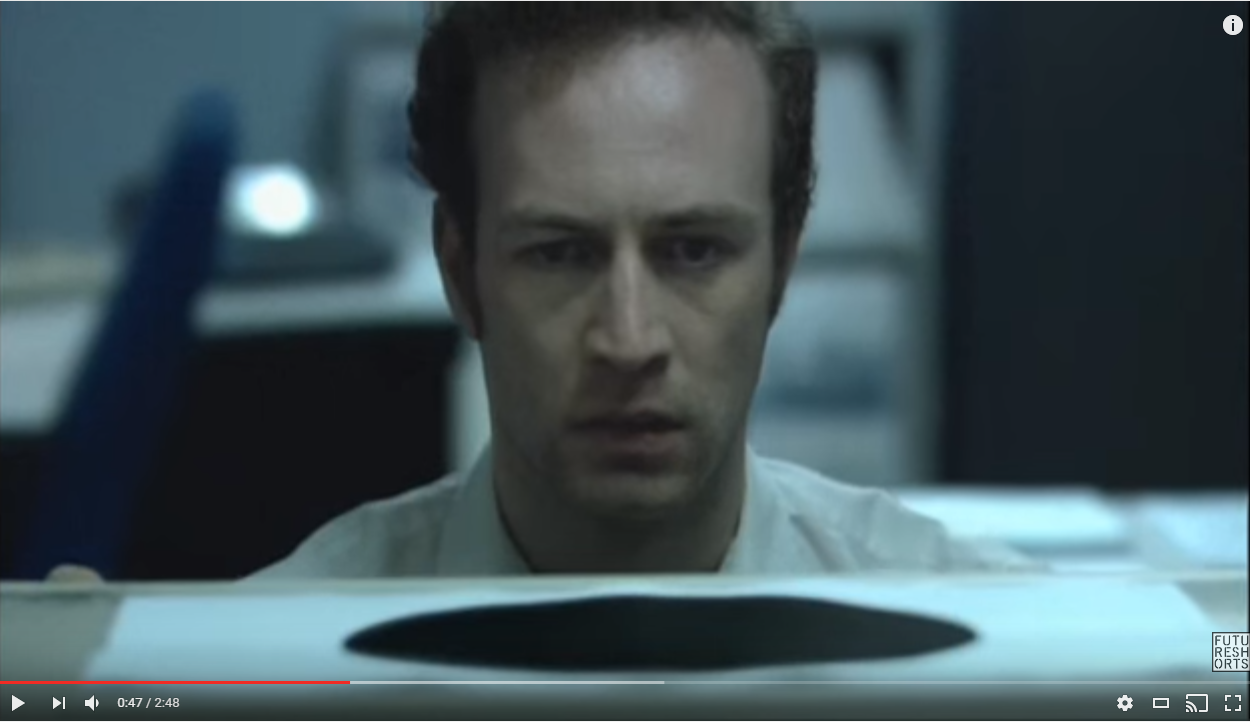
One of the key shots in this short film is a worm's eye view shot taken from the position of inside the black hole while it's on the side of the printer, this shot provides a small amount of foreshadowing as to what is going to happen in the rest of the film. This shot is followed by a medium shot of the man lazily placing his cup down onto the black spot, and it subsequently falling straight through. This scene is where the man discovers the power of the black hole that he now has. We also see a close up shot of the man's hand as he hesitates to put it into the black spot, the spot making on screen diegetic sound whenever he has his hand near it. The next shot we see is a MCU of the man as he puts his hand into the hole, still testing it's limits. The man has an excitable facial expression and his body language being slightly shaky is also indicative of excitement. Within the same shot, we see the man's eyes meet something which is out of frame, an eye line match is used and the camera is then focused on the vending machine which he was looking at.
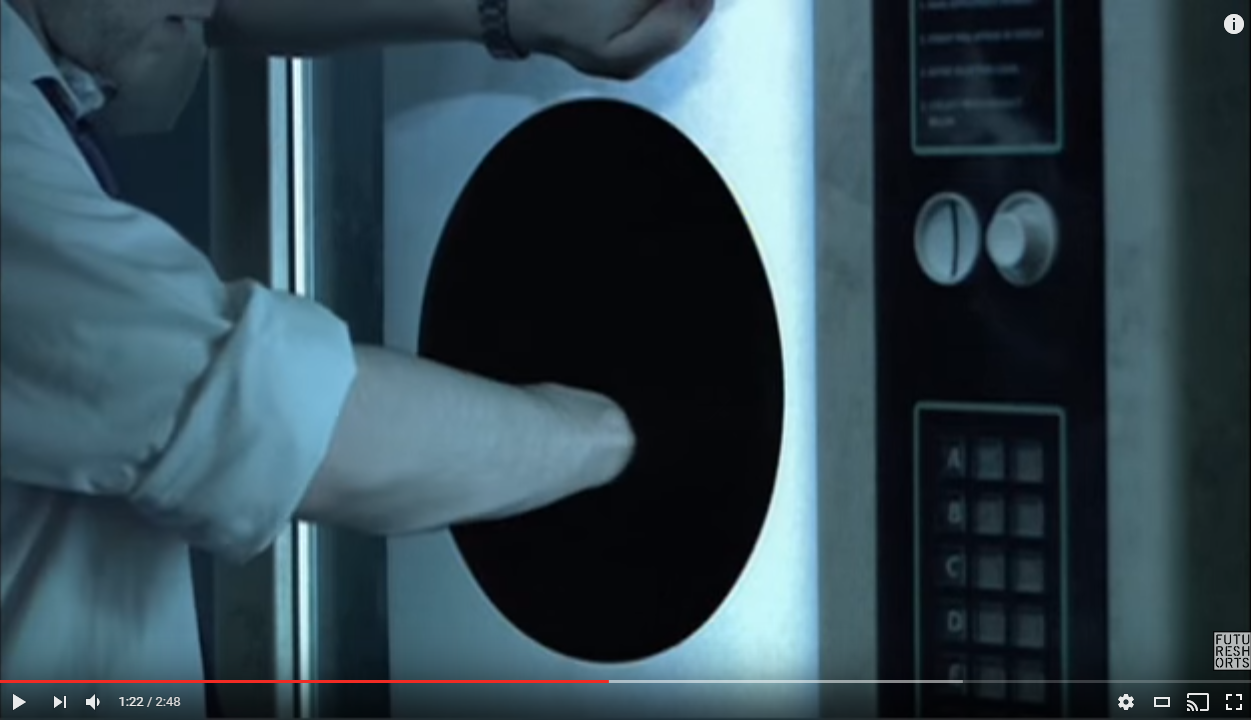
We next see a slow zoom towards the vending machine as the man approaches it with the black hole in his hands, the shot zooms from a medium shot to a medium-close up. The next shot we see is a close-up of the man reaching into the vending machine through the black hole as he places it onto the glass, he pulls out a chocolate bar with a look of shock on his face at the sudden realisation of what he can do.
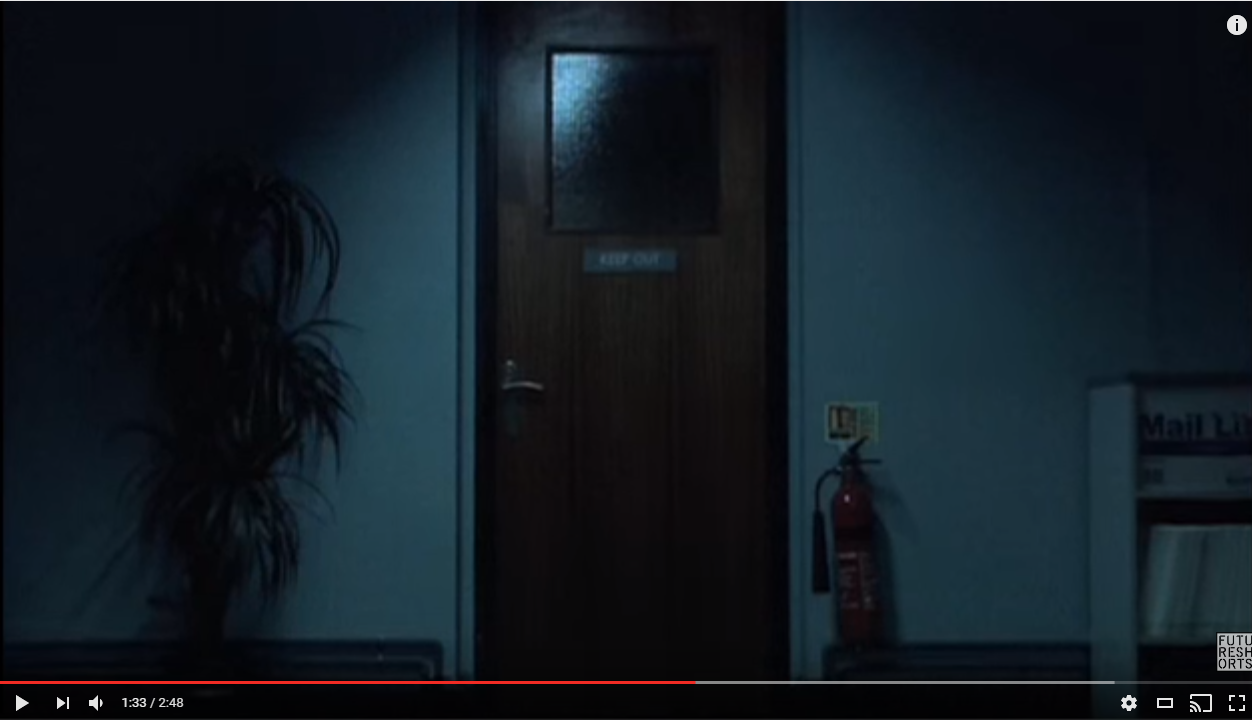
The next key shot we see is a slow zoom towards a door with the words 'Keep Out' on a sign just below a small blurred glass window. A similar zoom shot was used when the man was planning to reach into the vending machine, so in using this the director has shown us what his intentions are without telling us directly. We also see a close up of the man as he bites into the chocolate bar while looking at this door, he has a greedy expression on his face. This indicates that he still wants more, and he has only just got a taste. 

Next, we see a shot from the inside of the room behind the door the man was looking at, we see his silhouette through the blurred glass as he approaches it. We then see the man reach through the door through the use of a close-up of his hand, and then a shot from the other side of the door as he enters the room. The lights flicker as he walks in and his face is shrouded in darkness once he's inside of the room indicating that the man has bad intentions on coming into the room. We hear an off-screen diegetic sound of electric static as the lights flicker.

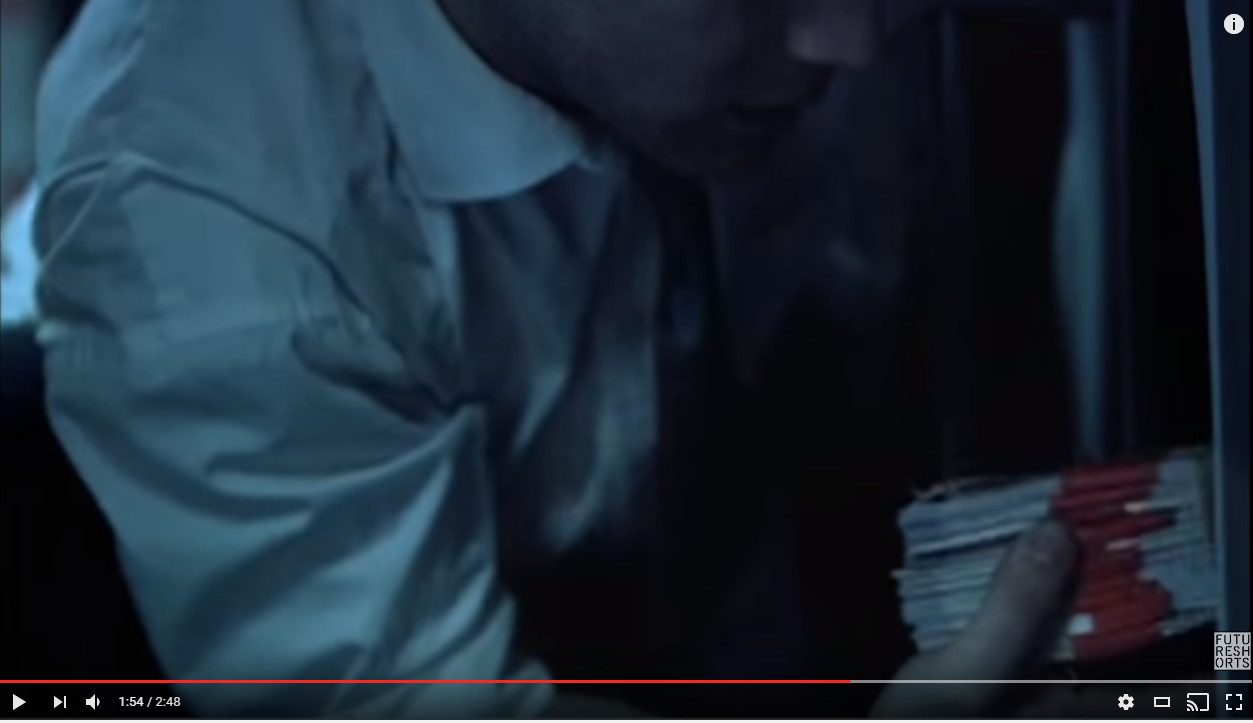
Once again we see a zoom shot of another object, this time, the camera zooms towards a safe that the man intends to take money from. We see a handheld medium shot as the man looks around for people before he reaches into the safe, even though he's in the office on his own, this shows the man's guilty conscience and that he knows he is being greedy and doing wrong. We see several cuts as the man takes more and more money out of the safe, with each shot the man is sweating more with anxiety.

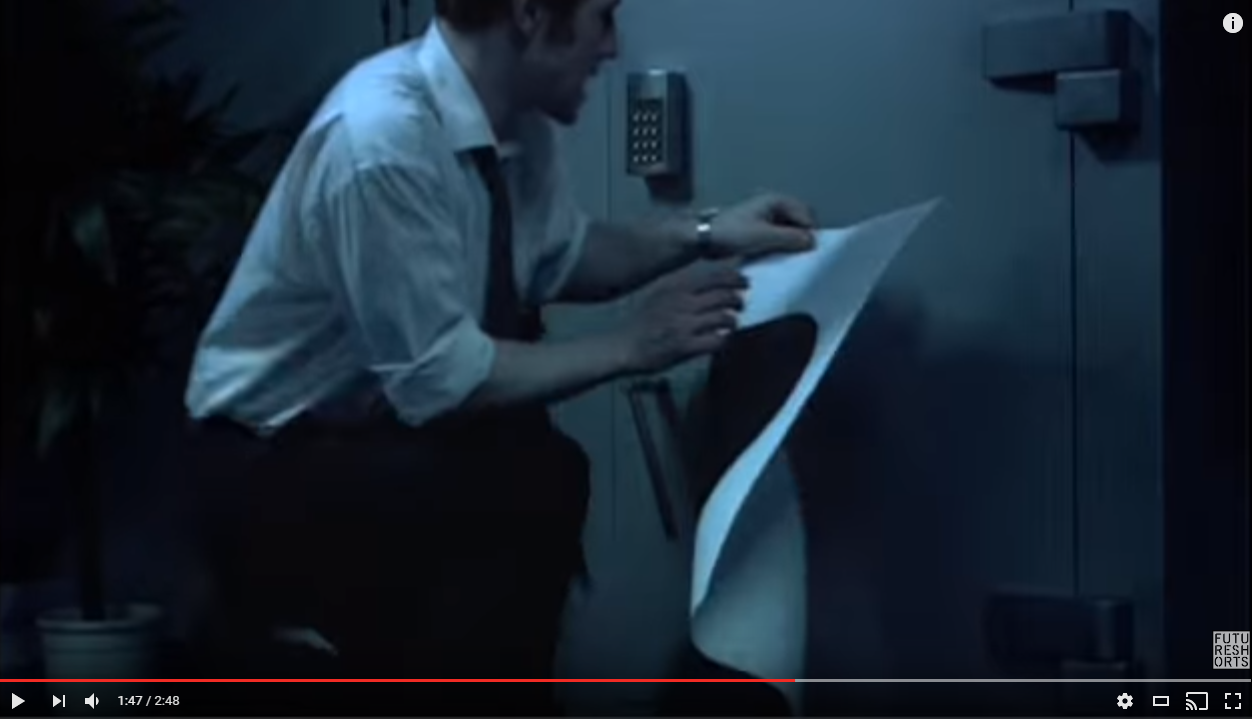
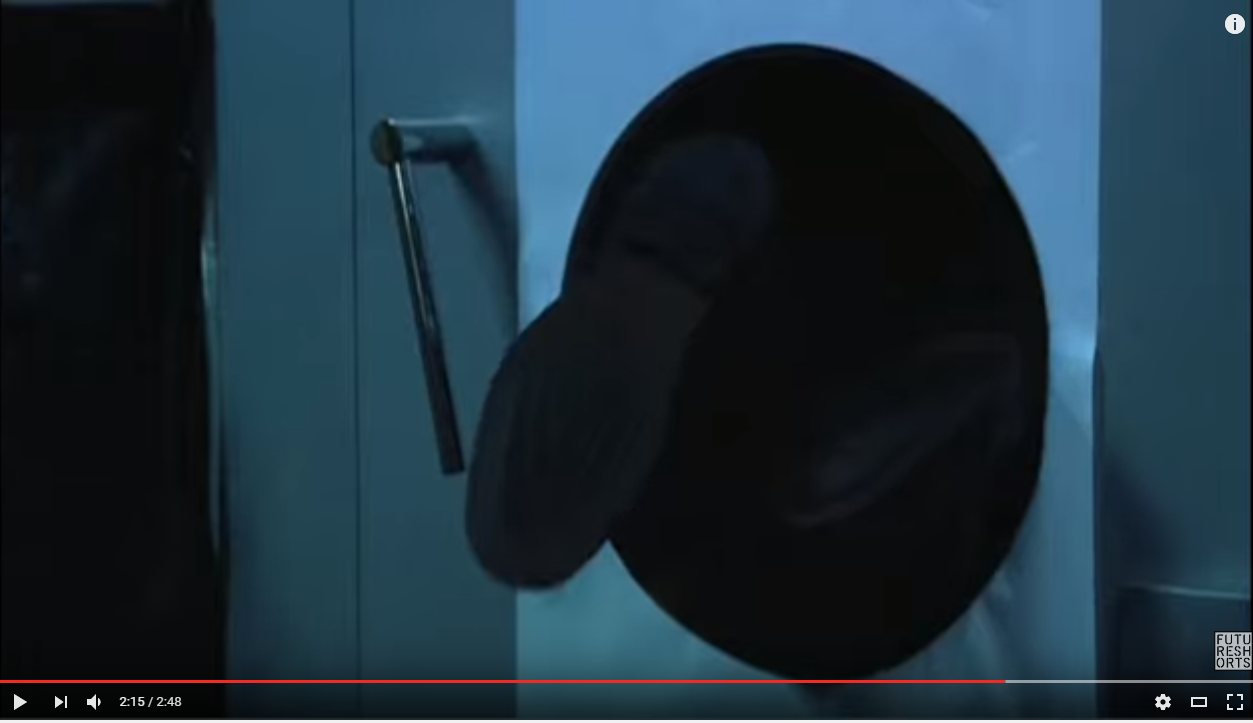
The next important shot we see is a close-up of the man placing his upper body into the safe and pushing the rest of himself into it. During this shot, we also cut to a shot of a small piece of tape holding the black hole onto the front of the safe barely holding. As we see the man's back foot come through the hole the tape gives way and traps the man within the safe. The final few shots are a close up of the safe, a medium shot of the safe, and then a long shot of the safe. The cuts between these shots are timed with the sound of the printer printing sheets of paper. We also hear diegetic sound of the man hitting the safe door repeatedly.
Narrative in THE BLACK HOLE:

Bordwell and Thompson's theory of plot and story can be applied well to this short film. The plot of the story involves the man gaining the ability to use a black hole to his advantage. The man gained this ability after the printer spitting out a piece of paper with a big black spot on top of it. After realising the ability of the black spot the man then uses it to steal a chocolate bar from a vending machine, his greed increasing he attempts to steal money from a safe in the manager's office which he broke into using the black hole. When attempting to steal the money the man is punished for his greed by getting trapped in the safe. The plot of this story is fairly basic, following the concept of a man gaining power, becoming greedy with it, and then being punished for his greed. 

There's a lot of information in this sequence which allows you to assume certain things about the story. One of these things is that we can see that the man doesn't enjoy his job, he looks very bored and despondent in the first scene before he finds the black hole. It is apparent that the man has been working here for a long time as his body language indicates that he is simply going through motions of things that he has done for many days before. This is also indicated by the excitement that the man shows when he discovers something's going to be different about his day when the black hole is introduced. We can also see a lot of old, worn equipment in the man's workplace, indicating that they don't care about their employee's conditions and that he is likely to be a very small cog in a very big machine.
Representation of class in THE BLACK HOLE:

When looking at representation in the black hole, there are two primary things that we can look at: the main character and his actions, and also the environment that the man is in. One of the first things we can see in the sequence is the man's clothing, he is wearing smart clothes but in a very shabby and lazy manner. His shirt and tie are both a mess, from this, we can gather that he doesn't want to be working here and that he cares very little about the job. Just from this we can gather that he is likely working class/lower-middle class, his job is likely to not be rewarding him and he doesn't enjoy it but he's trapped in it since he can't find another job.

The environment that the man is in also heavily indicates the class of the man since it's the environment that he is working in. Everything in the sequence is very dark and grey, with no significant colour at all. All of the technology in his workplace is old and worn, with old computers, and an old, dirty vending machine. This environment indicates that the kind of office job that he is working is in a place where the workers aren't treated well, which in turn indicates that he is of working class.
Short Film Analysis 2 - Sign Language - Jacob Knowles

Sign Language Analysis

Sign Language, Stephen Fellows + Oscar Sharp, 2010

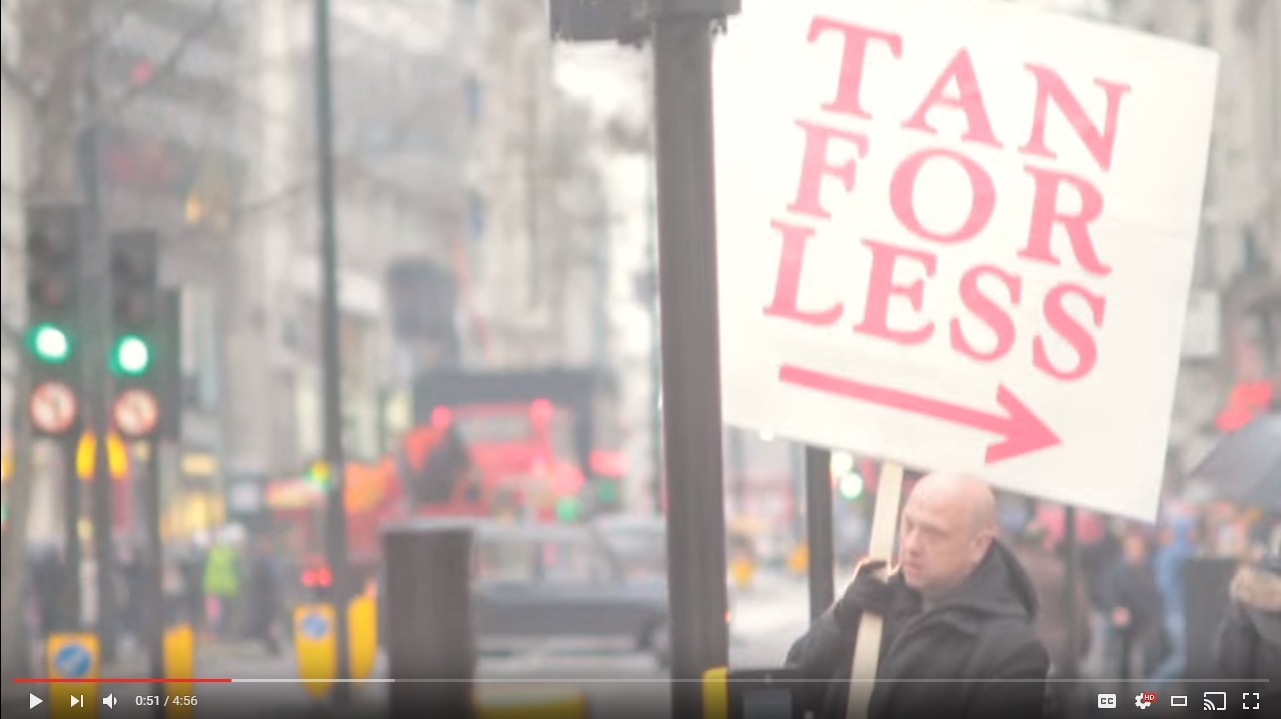
Sign Language is a short comedy film with romantic elements about a proud man showing his workplace, holding a sign up outside of shops. The film forces people to think differently about people's jobs and the world around them, since the main character, Ben, loves a job which most people would normally hate. The film also includes a female love interest which is shown from the beginning through Ben taking a flier from her which he has no need to take. The film shows Ben's last day on the job before becoming a skywriter and represents it in a very charming manner. Throughout the whole film, the main character is fully aware of the camera.

Media Language in Sign Language:

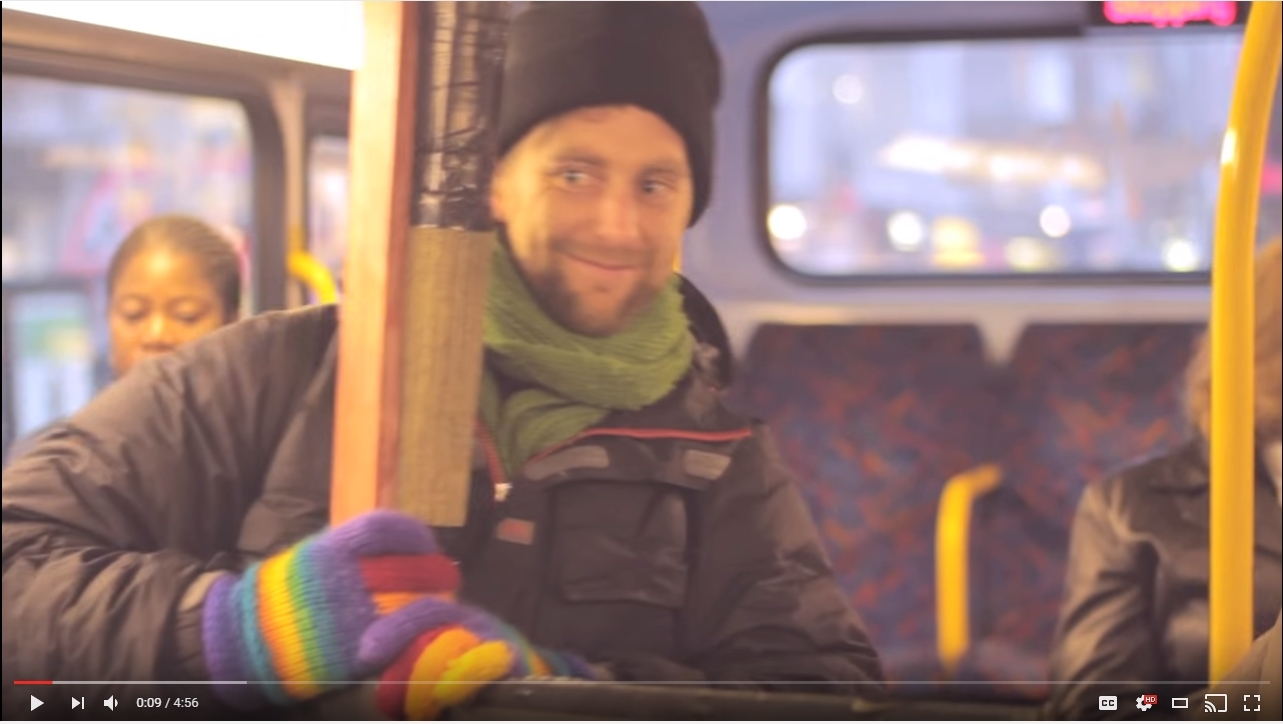
All of Sign Language is filmed with a handheld camera, consisting of mostly close-ups of the main character, Ben. The first shot we see is an ECU of Ben sat on a crowded bus, the shot has a focus pull from the street to Ben's face. We then cut to a medium shot of Ben standing up and getting off of the bus, during this time his body language is very cheery and kind. There is also a non-diegetic voiceover of Ben talking and explaining his job to the audience, which he describes as a 'Static Outdoor Information Technician' showing how proud he is of his job as holding a sign up outside of the shops on oxford street.


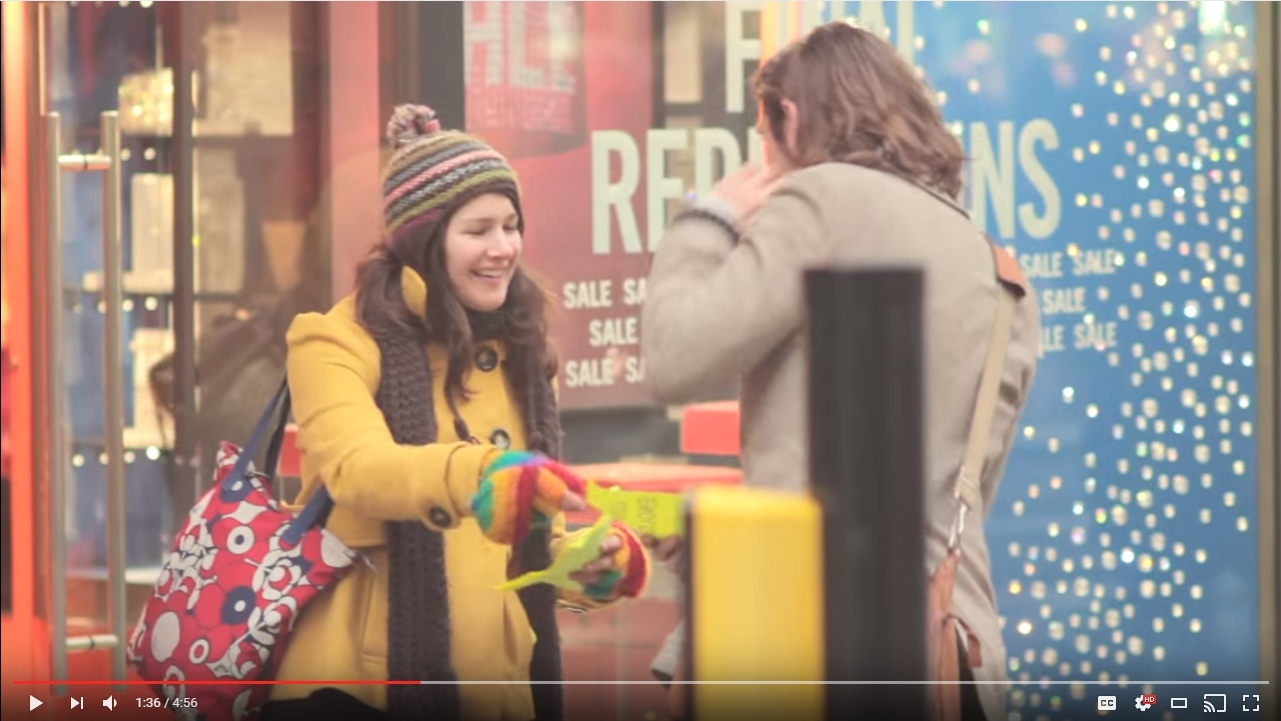
The title sequence in this film is very short, consisting of the title appearing on the screen and the rest of the image fading to black. We then see a cut to the next shot and the title fades away. The next shot we see has a shallow depth of field focused on the female character in the scene, this is the first introduction to the female character that we receive. Ben comes into the focus of the shot and takes a flier from the female character. We then see a close-up of the female character through the crowd as she is looking towards our main character, Ben.

Next, we see a shot of a sign which says 'Oxford Street', showing us the location that the film is both set and filmed in. As Ben is getting ready to hold his sign, there are several cuts in sync with the rhythm of the non-diegetic soundtrack. Through the use of the character Ben's dialogue, we are told about how the sign holding business runs in his family. When the character Ben is talking to the camera, a shaky handheld camera is being used. While retaining quality, in using a handheld camera a very personal effect is given, making it feel like he is talking directly to the audience.


When the character Ben is describing his employees, the focus pull technique is heavily used, bringing each of them into focus in turn, this emphasizes the personal handheld effect. There are also many cuts to zoomed shots in this short film when the main character is talking about his colleagues.

When Ben is talking about one of his colleagues, he mentions that they "held their sign upside down all day for a laugh" in a way that makes it sound like an exciting story. However, we can see that his work colleague isn't as excited and happy to work as Ben is. This is emphasized when he ignores Ben talking to him.

Another key use of Media Language in Sign Language is when Ben points out Anya. We see Ben looking in admiration over towards Anya, who was handing out fliers at the start of the film, an eye line match is then used to show her to the audience while Ben talks about her. Elements of Mise en Scene such as facial expression and body language are used to show Ben's admiration for this character.

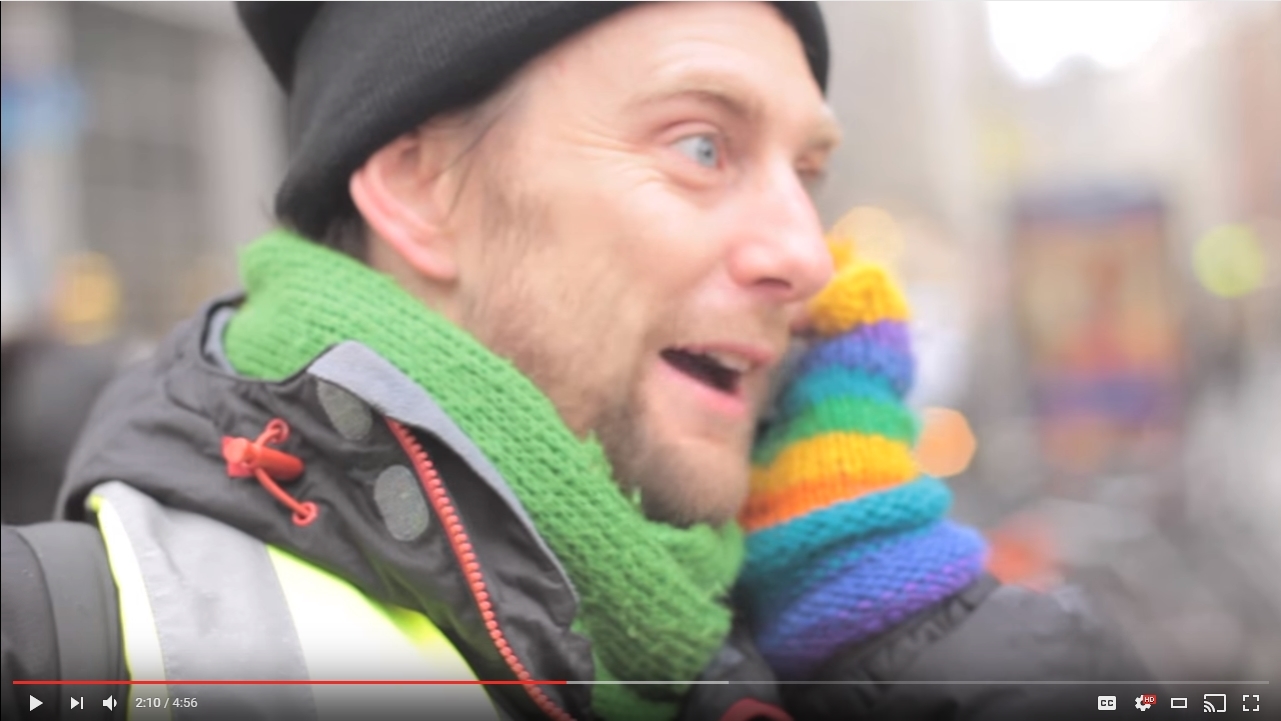
In this film the main character, Ben, is also made to be completely aware of the camera and often looks into it when talking.


Audience in Sign Language:

The audience that Sign Language is likely to target is of 18-35 year olds. The reason for this is that a lot of the key concepts in the film are easy to understand, and the film is very enjoyable without seeing some of the hidden messages within it and without being able to recognize the blossoming romance between Ben and Anya throughout.

The story in Sign Language requires the viewer to keep an open mind when trying to understand why the character Ben likes his job so much, this is why I believe the target audience is limited to people over the age of 18. The romantic elements of the film are also quite easy to relate to for this 18-35 age group as they happen to almost everyone. The media language and representation are also fairly easy to understand in this film and tell the audience a lot about what's happening all the time.

The film was also launched on Vimeo, it is more unlikely people outside of the 18-35 to view it on the Vimeo platform since it is quite a new and less well-known video platform. It is often that short films are posted on Vimeo since it is more of a platform for art than other websites such as youtube or in theaters, making it less accessible to a wider audience.


Genre in Sign Language:

Sign language uses both semantic and syntactic codes in order to show the audience that it's a comedy film with elements of romance. It is presented however like a documentary, so it has many of the codes that fit into that as well. One of the first semantic codes that represents romance as a genre shown in Sign Language is when the main character, Ben, walks past the female love interest in the film while shyly diverting his gaze towards something else. Despite doing this he still interacts with her by taking a leaflet, showing interest in her. The non-diegetic soundtrack in Sign Language is also indicative of it being a romance film, it is very relaxed and cheery and creates a romantic atmosphere in the film. 

There are two main codes that make the film fit into the comedy genre. The first of these is how seriously the main character, Ben, is taking his job despite how people would normally look at it. He goes into depth talking about all of the ins and outs of the job, and how long it has been practiced in his family. He also expresses that he's not hugely excited to move to his new job, which is as a sky writer.

The second code that makes the film fit into the comedy genre is the dry humor used throughout. For instance when Ben calls out to his colleagues without them replying on multiple occasions, but ben doesn't lose enthusiasm despite this.


Short Film Analysis 5 - MONEY BOX - Jacob Knowles

MONEY BOX Analysis

MONEY BOX, Muzappar Osman, 2014

MONEY BOX is a short film which explores the theme of greed, and in particular greed for money in our society. In the film we see a man realise that whenever he puts money into a vending machine and returns it, the money that he put in is multiplied by 10. He does this until it no longer works and he ends up with no money at all.

Audience in MONEY BOX:

The audience which is targeted by money box is of the age range of 18-35. I think that the film fits into this age range for multiple reasons. The first of these reasons is the platform that the short film is posted on. The Vimeo platform often has short films posted, however, it is mostly checked by people within this age range. Another reason that the audience is within this age range is that the concept of this film is most likely to be understood by people in this group. Although the concept of being punished for greed is not overly complicated, the film presents it in a way which isn't completely obvious to the viewer, and I think that setting the age range minimum at 18 is sensible in order to ensure that most people who watch the film will understand it.

On an individual level, the audience may be able to relate to the greed shown in the film. Beyond this, it is likely that the audience will be able to reflect on their own personality based on the greed shown in the film.

Narrative in MONEY BOX:

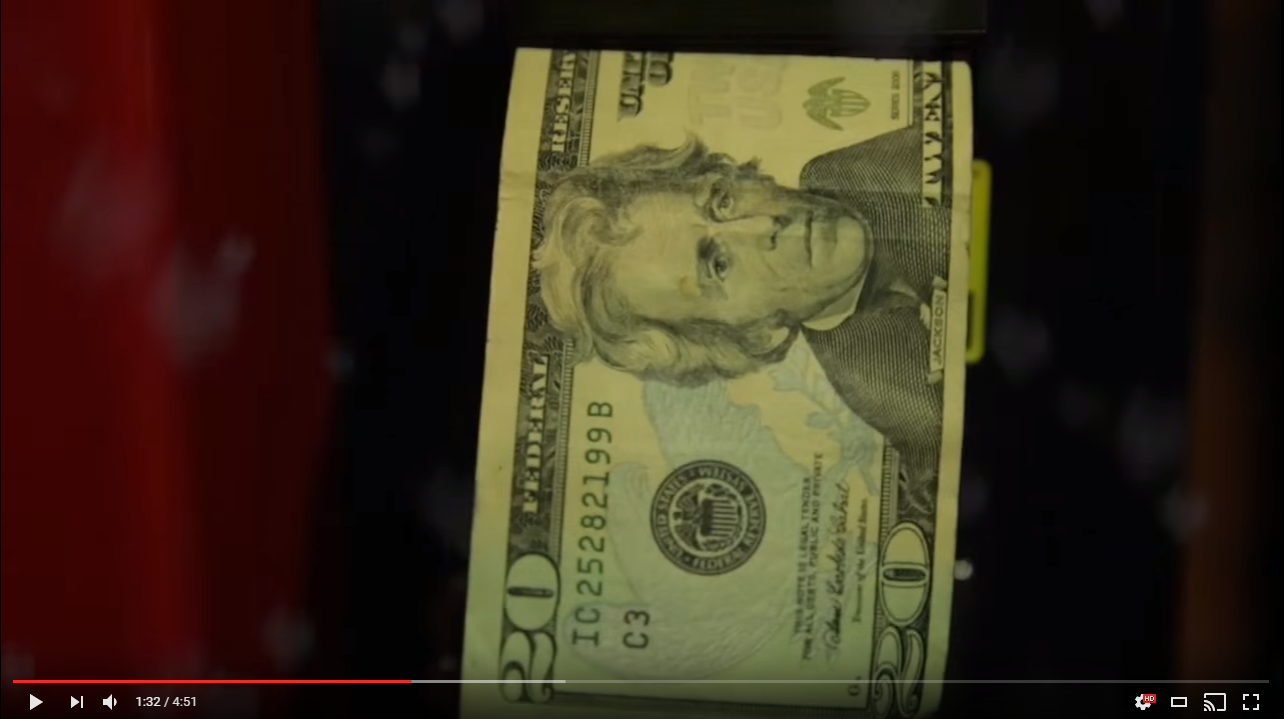
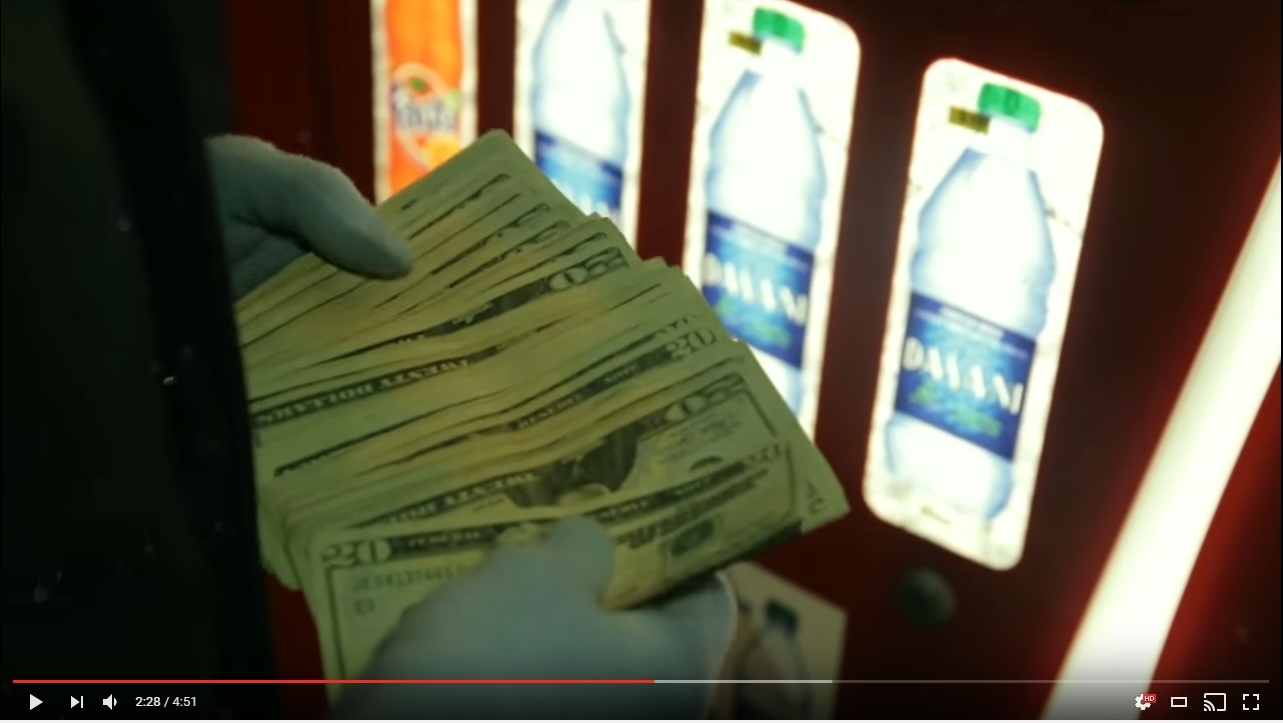
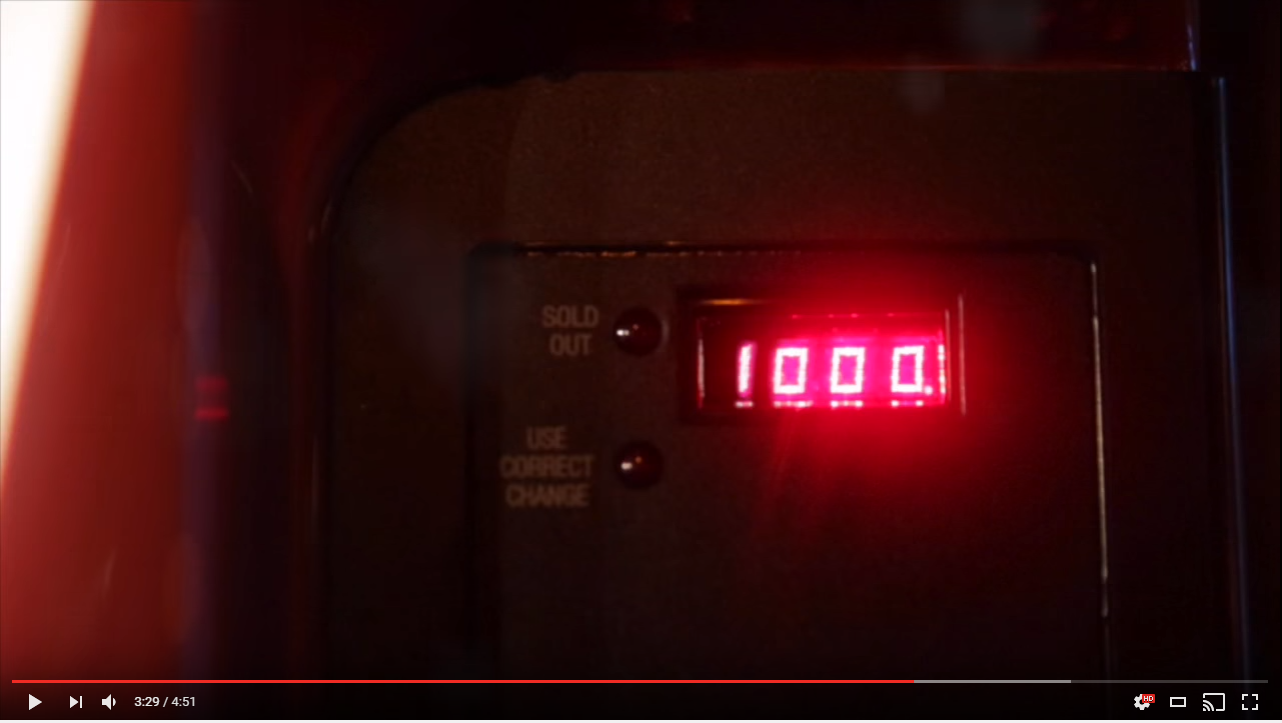
Todorov's Narrative theory can be applied to this short film, at the start of the film, there is equilibrium with the main character living a normal life without any obviously strange events being presented in the plot. The disruption happens when the man realises that he can multiply his money by a factor of 10 whenever he wants to using the vending machine, this creates a greed in the man which is the disruption present in the film. The confrontation in MONEY BOX happens at the same time as the resolution, it takes place when the man puts several thousand dollars back into the machine and the power of the city shuts down, leaving him with nothing at all.

Not much can be assumed of the story in this film, though the plot is simple and obvious. The story that can be assumed is that the man has either left the house without any money or does not have any money to spend. The way that he is dressed suggests the former of those two possibilities is the most likely. The man also looks like he's a student, or possibly a young worker.
This short film sports a simple linear narrative, with all of the events happening in chronological order.

Wednesday, 21 September 2016

'Snap' Short Film Research - Oscar

Snap

Snap is a short film about a guy who steals a variety of different peoples cameras and lets them chase him so he can take some good photos, he also has help from other people that try and make the photo look even better. In the end we find out he never actually wanted to steal the camera he just wanted some good phtots for his gallery and you see him friends with the people he pretended to steal from at the end of the short film, so in the end it is a happy ending and a jolly film. 


Narrative:
The structure of the story follows Todorovs rule of equalibrium dis-equalibrium and new equalibrium to perfection as the begining we see an unknown guy having a drink in a cafe, he then leaves walking towards a family who are taking photos of each other he tricks the family into thinking he wants to take a photo of them and runs off with the camera and the father of the family chases him.


This beginning sequence tricks us into thinking this will be some sort of thriller as he runs off with a non-diegetic chase soundtrack playing in the background. after a bit of running he goes behind a wall and appears again with different clothes on and a different person chasing him.
This is when the middle of the narrative really starts to make sense we then see it fluxtuate to another character and the same thinng is happening and random people are doing weird things to the people running after who we beleive is either the protagonsit or antagonsit.
At this point we still dont know whether this guy is good or bad? We still beleive he is a thief but perhaps for a good reason seeing that a majority of people are helping him.
We then get to the end of the narrative the original character in the white shirt has cornered the thief and we think a fight will possibly happen but then it cuts to the pictures he took in 
a kind of gallery, it then becomes clear that this was the 'thiefs' intention the whole time to get some good photos of the chase and the reason why people helped him out.
It then cuts to a longshot where we see the people who chased the man taking photos and smiling with him in the gallery which must mean he gave the camera back and infact he is the protagonist not the antagonsit.
This is an example of linear narrative as the story has a clear begining, clear middle and a clear end. 

Audience:
The audience for snap seems to be young adults and teenagers, the main character who steals the cameras looks like he is in his early 20's which would be a good technique to draw that target audienec in, it is also a light hearted and at times funny which could be seen as childish making it appeal to teenagers but also hasa  relativey serious message which stops the audience from being particualry young.
I beleive snap has a hidden agenda yeah it is a light hearted short film but at the same time its telling us two things the first is 'dont judge a book by its cover'; at first we all thought this was a thief trying to steal a camera but it turned out being a normal guy thinking outsdie the box trying to get some pictures for his art gallery.
This follows up nicely to my second point. Snap is directed to young people (its target audience), which means its trying to give a possible message to younger people who are starting work etc, I beleive the message is to think outside the box and if you want to make it in life its to do things that make you rememebred, things that will get you the best results. The protagonsit may of been at risk in getting beaten up or in trouble with the police but he risked it and it turned out to benefit him he got some quality photos and his own gallery at a young age which prooves that if you do whatever it takes you can make it. 

Genre:
Snap is a perculiar film with aspects of a mild thriller and a mild comedy it isnt intense and it isnt very funny but it does contain aspects of them. At the begining you see three consecutive shots of an unknown foreign man at a cafe spying on this american family, its all very sinister as it begins to look like the begining of a stereotypical thriller film. Its not until the chase begins and the incidents with other people throwing water or getting in the way when we start to see the attempted comedy side of the sotry, there is also a close up at the end when the protagonsit is cornered and he says 'I've ran out of film' and it just confirms this was all a bit of a joke in the end. The lighting for snap is also very colourful and bright indeed it is a sunny day and that firthermore confirms this is abroad but it also is an aspect of a jolly film as a proper thriller would usually contain a darker hint. It then has a jolly happy ending which is a strong aspect of a comedy which furthermore confirms indeed Snap went from a potential thriller to a comedy in the matter of minuiutes.


Short film analysis 1 - Two & Two - Jacob Knowles

Two & Two Short Film Analysis

 Two & Two, Babak Anvari, September 17th 2011


Two & Two is set in a school which is governed by a communist/authoritarian regime. A seemingly normal day is completely turned around when all of the, identically uniformed, male pupils are told that something they had always been taught as fact is now false. When certain students speak up against the teacher, what may have seemed to be a joke becomes very real as each of the students are forced to question how hard they are willing to fight for their beliefs. The idea that 2 + 2 = 5 being established through force may seem ridiculous, but the film is an allegory for dictatorship and tyranny. 

Narrative in Two & Two:

One of the key narrative theories is Todorov's Narrative Theory. Todorov's theory applies to this film differently to how it does other films as there are multiple disruptions. The film starts in an equilibrium with all of the school children talking together in the classroom, they then very quickly go silent and stand to attention when their teacher walks into the room. The first major disruption comes when the teacher starts telling the children that two plus two is equal to five, with all of the children being confused but agreeing with the teacher in order to not cause trouble. The second major disruption comes when one of the children speaks up against the teacher, saying that two plus two infact equals four. The student argues with the teacher and continues to hold his ground with the tension constantly building, higher students which represent high officers in the film then enter the room to deal with the child and to give him one last chance. Each of the higher students is 'holding' a 'gun' which isn't really there, the child still disagrees with the teacher and is then shot. The child being shot is the resolution phase of Todorov's narrative theory, showing the other children in the class power and forcing them to adopt the new regime. The 'two plus two is equal to five' disruption then subsequently become the new equilibrium. 

The narrative in this short film is circular, this is because the film begins with the teacher telling the children that 'two plus two is equal to five' and ends with the same. There is also a shot of the teacher standing in the middle of the class at both the beginning and end of the film. The film uses restricted narration.

Audience in Two & Two:

The audience that Two & Two is targetting is mainly an adult/late teen audience. The reason for this is that the film is making a heavy political statement, the film representing a strict authoritarian regime and how it would apply if it was set in a classroom. I think that this message is going to be most well understood by people that already have some knowledge on the subject, which may be limited to an older audience. The film very well represents how people gain power through intimidation, the children may represent the general public and the teacher may represent a dictator or a figurehead for an authoritarian society.

Although I think that this film is primarily aimed at an older audience, I think that the film sends a message that's important for everyone to hear. The film twists the audiences expectations when the teacher introduces the concept that 'two plus two is equal to five', the audience will recognise that this is false and be surprised that it is being taught in the class. The primary twist of the story is where the child is shot with the invisible guns, with the concept of 'two plus two is equal to five' already being ridiculous, the fact that lethal action would be taken is shocking.

Genre in Two & Two:

Two & Two fits into the genre of drama as the events are shocking and it keeps the viewer on edge, however it doesn't have many of the components of thriller or horror. The whole film takes place in a very plain room with grey walls and floor, the only significant features being a map on the wall, a window on the opposite wall, and a blackboard on the far wall. There is also a desk at the front of the room. The children in the film are all male, with no female characters. All of the children wear an identical uniform with plain white shirts, with plain white trousers, although this is not an abnormal style for a uniform the dirty grey setting emphasizes that they are strict on the children but don't put in the effort themselves. The teacher is wearing a suit, this establishes authority over the child characters as they are wearing more simple, plain clothes. The higher students, which represent guards or high officers are wearing red arm bands which are very similar to the ones which nazi guards wore during the nazi reign. This is likely what the director was trying to represent.